
AI Governance Consulting: From Framework to Technical Implementation
Regulatory pressure around AI is rising fast, and frameworks like the EU AI Act now require companies to move beyond intentions and prove operational compliance through concrete, auditable controls.
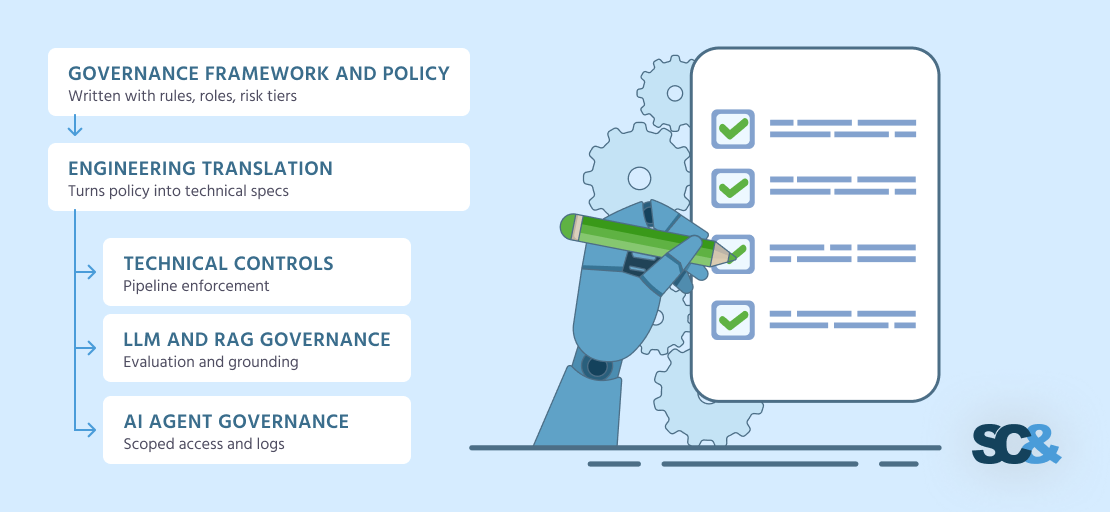
At the same time, adoption is accelerating faster than organizations can govern it. A December 2025 study by the Cloud Security Alliance and Google Cloud found that companies with comprehensive AI policies are nearly twice as likely to safely deploy agentic systems compared to those still working with partial guidelines.
This is where AI governance consulting becomes essential. Unlike traditional IT governance consulting, which focuses on infrastructure and data policies, AI governance requires translating ethical principles and legal requirements into technical controls. The real challenge is not writing a framework, but implementing it inside working systems.
Why Enterprises Turn to AI Governance Consulting
Enterprises increasingly seek AI governance consulting not because they lack ambition, but because internal capacity has not caught up with the pace of deployment. Four pressures push organizations toward external expertise: accelerating adoption, missing internal skills, tightening regulation, and the need to align departments that rarely speak the same language.
AI Adoption Is Outpacing Governance Maturity
Organizational AI adoption reached 88% in 2025, according to Stanford HAI’s 2026 AI Index Report. At the same time, documented AI incidents rose sharply. Deployment is scaling faster than the oversight needed to keep it safe and accountable.
Internal Teams Lack Structured Governance Expertise
Building internal capacity takes time that fast moving AI projects rarely allow. Most organizations still rely on general IT or legal staff to oversee AI systems, without dedicated training in model risk, bias testing, or algorithmic accountability. That leaves governance decisions in the hands of teams stretched across unrelated priorities.
Increasing Regulatory and Audit Pressure
Legislative activity around AI has multiplied rapidly across jurisdictions, creating overlapping and sometimes conflicting requirements. Enterprises operating internationally now face constant audit obligations, making it difficult to maintain compliance without dedicated legal and technical expertise on staff.
Need for Cross-Functional Alignment
AI governance cannot succeed inside a single department. Legal, risk, IT, and business teams often work independently, applying different definitions of acceptable risk and different review processes. Without a shared framework connecting these functions, governance decisions become inconsistent and difficult to enforce across the organization.